Why I Treated My Heart Like a Longevity Investment, with a Cleerly CCTA Scan
What Cleerly adds is the part that matters most. It's an FDA-cleared, AI-driven platform that analyzes those CCTA images and builds a **3D model of your coronary arteries** — then quantifies and characterizes the plaque inside them. It doesn't just tell you *whether* an artery is narrowed. It measures **how much plaque you have, where it is, and — critically — what kind it is.**
Sean P. Carr, CISSN, NBC-HWC
June 17, 2026
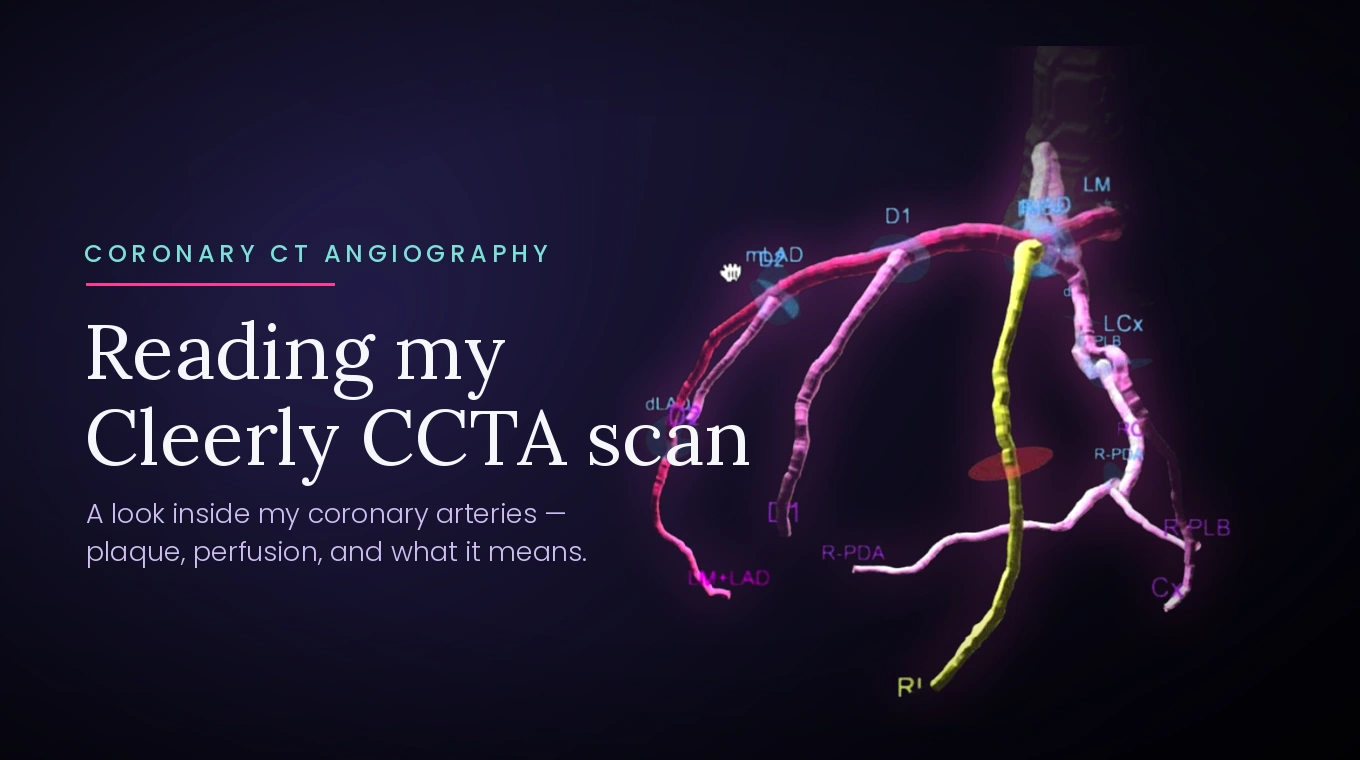
What I learned from my Cleerly CCTA scan.
This year, on my 50th birthday, I'll be running five miles between eight brutal functional-fitness stations at HYROX Nashville.
I want you to sit with that for a second, because there was a long stretch of my life where that sentence would have sounded like fantasy. A podiatrist once told me I'd never run again. Well, he may have said I SHOULD never run gain, but it's my story so I'm going to remember how I like.
So when I tell you I no longer believe people have hard limits, It's not for some cheesy motivational poster. I'm telling you what I learned by living it.
But this post isn't about the past. It's about a decision I made after my bloodwork was finally optimal, my body composition was dialed in, and I still chose to spend a little over $2,000 to look directly inside my own arteries. I want to walk you through why, what the scan actually is, and the honest conversation we all need to have about where our health falls in our list of priorities.
The day everything changed
In 2017 I turned 40, got married, and moved into a new home. As life tends to life, my diet and training took a back seat for a bit. So I decided to get back at it.
Then everything changed overnight.
I had a "bike accident." I call it that because it sounds far more badass than the truth, which is that I was riding my Peloton at home and woke up the next day unable to put any weight on my foot. I couldn't walk. Crutches and a knee scooter became my world. Every time I tried to get back to exercising over the next few years, I'd re-injure it and end up immobile again. My Achilles was the problem, and with it I ballooned from a heavy-set 190-pound guy to over 316 pounds.
My doctor's prognosis was blunt: I would likely never run again. The best I might hope for was a little more mobility and a little less pain — if I could lose the weight.
A weight-loss surgery that nearly killed me, and years of steady improvement, learning to optimize every aspect of my physical, mental, and spiritual health, here I am. Running. Training for HYROX. On my 50th birthday.
So, why did I scanned my heart, when my labs were perfect
By the time I'd rebuilt myself, my bloodwork was sitting in optimal ranges across the board. Most people would call that a finish line.
I didn't.
I'd been to some genuinely dark places metabolically and otherwise. I'd done the work to climb out. But optimal labs today don't erase the question of what all those years left behind. Lipid panels and risk calculators tell you about probability. They don't show you what's physically happening inside the walls of your arteries right now.
I wanted to see it. So I talked with my doctor, and we ordered a Cleerly CCTA scan.
What is a Cleerly CCTA
CCTA stands for coronary CT angiography — a non-invasive CT scan, done with a contrast agent, that images the arteries feeding your heart. On its own, that's a well-established cardiac imaging tool.
What Cleerly adds is the part that matters most. It's an FDA-cleared, AI-driven platform that analyzes those CCTA images and builds a 3D model of your coronary arteries — then quantifies and characterizes the plaque inside them. It doesn't just tell you whether an artery is narrowed. It measures how much plaque you have, where it is, and — critically — what kind it is.
That last point is the whole game. Not all plaque is equal:
- Calcified plaque is older, more stable, and easier to spot. A standard coronary calcium score is built around it.
- Noncalcified ("soft") plaque is the more dangerous kind. It's the plaque most likely to rupture and trigger a sudden heart attack — and it's exactly the plaque a calcium score can miss entirely.
This is why I'm cautious about people walking away reassured by a single number. You can have a calcium score of zero and still be carrying soft plaque. Cleerly's AI is designed to find and quantify that — distinguishing the stable from the vulnerable, and giving you a total plaque burden you can actually track over time as you change your training, nutrition, and medications.
This kind of imaging used to live almost exclusively in the world of symptomatic cardiac patients and people with the means and the connections to seek it out. That's changing fast — as of January 2026 there's even a dedicated reimbursement code for AI coronary plaque analysis — but it's still far from standard. And that gap, between what's possible and what most people are offered, is precisely the gap DeNovo Longevity exists to close.
My results
After the scan, I got to do something most people never do: I sat with my doctor and looked at my own heart and arteries rendered in 3D.
There was plaque — a small, predominantly noncalcified amount, low enough to land me in the most reassuring category for someone my age. Functionally, my coronary arteries were close to pristine. After everything my body had been through, that's a result I don't take for granted.
And here's the honest part: I would have wanted that scan no matter what it showed. If it had come back with significant soft plaque, that would have been the single most useful thing I could possibly know — early, while I still had every lever to pull. Good news is a relief. But the point was never to collect good news. The point was to understand my real risks so I could deal with them appropriately, on my terms, with my eyes open.
For me, that also means not letting an insurance company dictate which tests I'm "allowed" to have.
Was it worth $2,000
The Cleerly scan ran me a little over $2,000. That's not cheap, and I won't pretend otherwise. Not everyone will be able to pay that out of pocket, and I'd never tell you they should.
But I want to share something I've seen again and again, because I think it deserves an honest look.
Most of the clients I've worked with who told me they couldn't afford a $2,000 test had no trouble finding that same $2,000 for a new iPhone. Or a big-screen TV. And, in at least 1 case a monthly car payment nearly twice what a Cleerly scan cost. The money was there. Investing it in their health simply wasn't on the table — it had never made the list.
I don't say that to shame anyone. I have no financial interest in Cleerly or any other testing company — I'm not selling you a scan. I say it because being honest with ourselves is the starting point for every good decision, and because what we choose to invest in says something about what we've quietly decided matters.
I'm not here to tell you to run out and get this scan. I genuinely don't advocate for unnecessary testing — some tests carry far more value than others, and the right move depends entirely on your circumstances, your history, and a real conversation with someone you trust to talk about your health with. There's no universal right answer here.
I'm only asking you to think about it:
When you map out what you prioritize — what you'll happily spend on, what you'll save for, what you'll finance — where does your health actually fall in that decision?
There's no wrong answer. Just food for thought.
Test, don't guess
I spent years being handed limits. You'll never run again. Just eat healthy and exercise. Your numbers look fine. Some of those statements were well-meaning. Most of them were guesses — generic answers applied to a body that turned out to be anything but generic.
Everything changed for me when I stopped guessing and started measuring. When I learned how my cells adapt, how my body handles hormones, and finally, what my arteries actually looked like from the inside.
That's the whole philosophy at DeNovo Longevity & Performance, and it's the one piece of advice I'll stand behind without hesitation. When it comes to your health, or your performance, for results you can trust:
Test, don't guess.